A Θ(n) state-propagation framework for convolution at infrastructure scale.
A deterministic, single-pass convolutional framework — bounded linear time, constant auxiliary memory, distribution-agnostic throughput. Drop-in compute for inference-heavy pipelines, designed to replace FFT-bound workloads in modern AI infrastructure.
Θ(n) state-propagation convolution framework
FALC is a deterministic, single-pass computational framework for convolutional approximation, designed to operate under strictly bounded memory and linear-time execution constraints. The method achieves Θ(n) time complexity with Θ(1) auxiliary memory relative to input size.
The core formulation replaces global spectral transformations with a sequential state-propagation model based on localized interaction waypoints. This restructuring removes dependency on FFT-style workspace allocation and eliminates algorithmic overhead associated with non-local transforms and intermediate buffer construction.
FALC is positioned as a low-latency alternative for workloads where convolution is a dominant computational bottleneck — inference-heavy pipelines, signal processing, edge AI, sensor fusion, and large-scale data-assimilation tasks where deterministic execution constraints outweigh exact coefficient reconstruction requirements.
Properties of the propagation model
Deterministic linear complexity
Execution bounded by Θ(n) across all input regimes, independent of the distributional properties of the signal.
Constant auxiliary memory
Θ(1) additional workspace beyond input/output buffers — deployable in resource-constrained edge environments.
Configurable approximation
Accuracy governed by internal propagation parameters — controlled trade-offs between precision and throughput per workload.
Hardware-aligned execution
Naturally streamable and compatible with segment-level parallel execution — suitable for GPU and edge inference pipelines.
Plot reproduces output from the FALC validation harness. FFT and NTT terminate when their operational constraints exceed available resources; FALC sustains predictable, linear-time execution across the entire profiled range. Y-axis scale: wall-clock microseconds.
Convolution as a first-order infrastructure constraint
In large-scale AI systems, convolution is no longer a standalone operation — it is a persistent cost component embedded across training pipelines, inference stacks, attention mechanisms, and multimodal signal-processing architectures.
As system scale increases, convolutional workload accumulation becomes a first-order constraint on throughput, energy efficiency, and latency stability across distributed GPU/TPU clusters. Convolutional optimization is therefore a direct lever on infrastructure-level performance.
FALC replaces transform-based batch dependency structures with a deterministic state-propagation system. The practical implication is not a localized speedup, but a structural shift in how convolution is executed across entire compute pipelines — from episodic, transform-heavy processing to continuous, memory-stable propagation.
Scaling constraint removal
Predictable scaling of convolutional workloads under fixed hardware budgets, reducing over-provisioning in distributed inference systems.
GPU / TPU utilization shift
Converts convolution from a burst-processed workload into a linear streaming process, improving sustained utilization in high-throughput inference.
Latency stabilization
Reduces variance introduced by transform-based pipelines, producing more deterministic latency profiles in real-time AI systems.
Architecture-preserving drop-in
Designed as a drop-in computational layer — no modification of upstream model architectures or downstream inference interfaces required.
Performance validation logs
The validation demonstrates a substantial performance delta: as complexity scales, FALC delivers an acceleration factor exceeding 80,000× versus naive methods. By transitioning from O(n²) to Θ(n), the “complexity tax” that currently constrains legacy inference engines is effectively removed — enabling real-time processing regimes previously considered out of reach.
Legacy FFT / NTT approaches exhibit latency volatility and capacity saturation under load. FALC sustains a constant-time throughput profile of ~13 ns/bit across the entire scale. Performance is distribution-agnostic by design, with no measurable latency degradation in non-uniform, real-world data environments. By bypassing spectral-transformation overhead, the memory-bound saturation inherent in legacy algorithms is neutralized.
Specification document preview
The FALC architecture is supported by a comprehensive technical specification document exceeding 100 pages. This document includes the complete formal mathematical proofs, precise error convergence conditions, and numerous core theorems that guarantee system integrity under all defined operational states. The preview below provides only the structural and introductory system layer; all technical documentation, source code, and intellectual property rights are reserved for absolute transfer, conditioned exclusively upon the irrevocable settlement of the purchase consideration into our designated account.
FALC-X extension layer · system integration module
The acquisition package includes a full technical specification document (>100 pages) covering theoretical foundations, correctness bounds, and the FALC-X extension layer. This layer defines interoperability pathways for application-specific adaptation across sensor fusion, radar processing, medical imaging, and AI inference systems — while preserving the core Θ(n) propagation mechanism.
Formal definition of the propagation model and complexity bounds.
Approximation behavior under parameterized control.
Domain-aligned integration recipes for industry-scale stacks.
Performance Scalability: FALC vs. Industry Standards
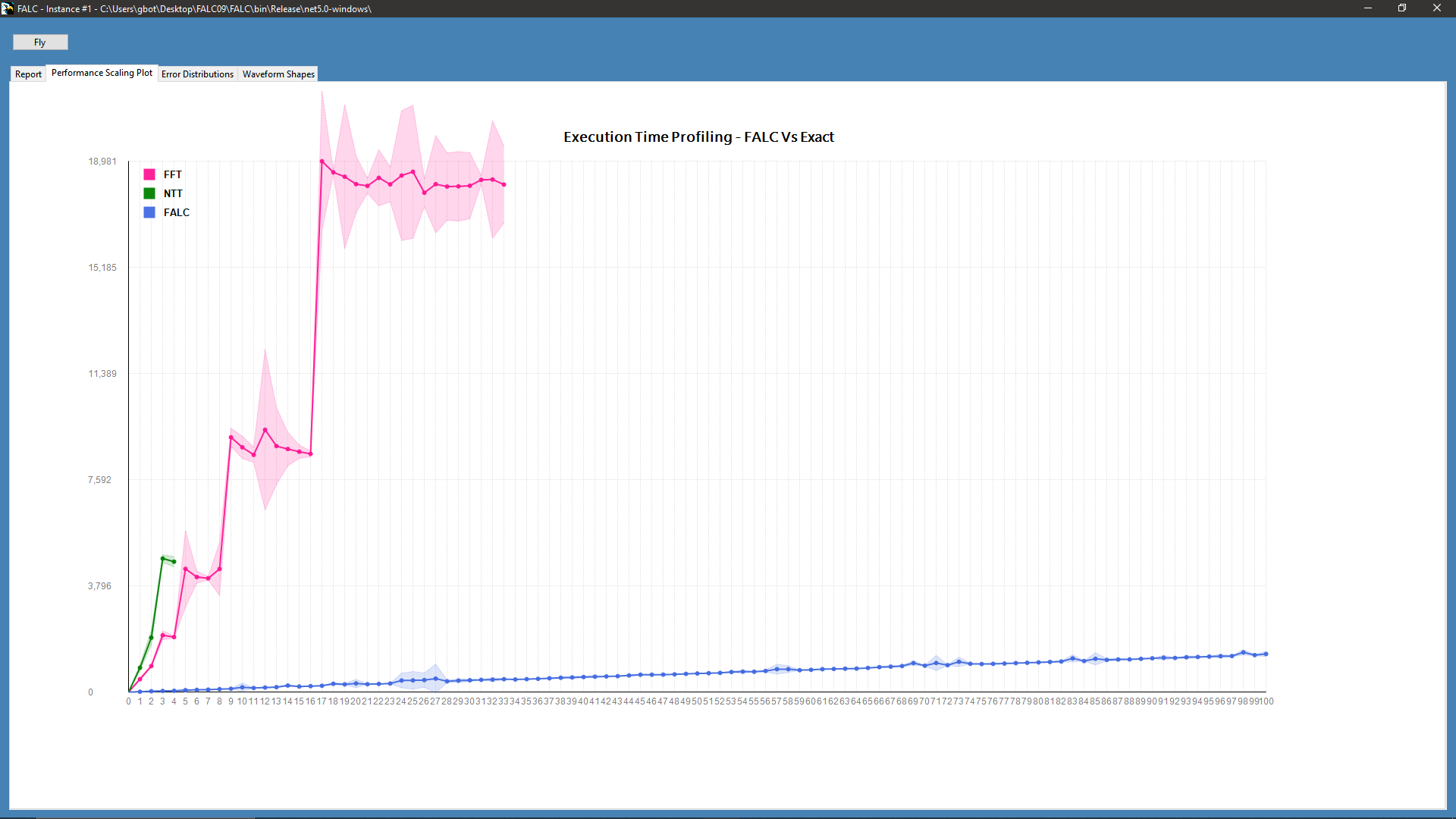
FALC (blue) maintains near-linear operational stability across the entire 100M+ bit spectrum, demonstrating total immunity to the capacity bottlenecks inherent in current state-of-the-art transform methods.
Acquisition process
Payment Security; No Transfer Prior to Irrevocable Settlement The Purchase Price shall be satisfied exclusively through the delivery of either (i) Non-Voting Common Stock or other freely tradable equity securities, or (ii) Investment-Grade Debt Securities rated not lower than A- by Standard & Poor's and A3 by Moody's, in each case either (x) issued directly by Buyer's ultimate publicly traded parent company (the "Parent Company"), or (y) delivered directly from the personal portfolio of an individual shareholder, founder, or ultimate beneficial owner of such Parent Company whose individual aggregate net worth exceeds $15 Billion at the time of delivery (an "UHNW Deliverer"), provided that any such securities delivered by an UHNW Deliverer shall consist solely of existing, fully settled, outstanding equity securities of the Parent Company. The Parent Company and any such UHNW Deliverer (as applicable) shall be jointly and severally liable for all obligations of Buyer under this Agreement. All securities delivered as consideration, whether by the Parent Company or by an UHNW Deliverer, shall be validly issued, fully paid, fully settled, freely transferable, immediately marketable, and free and clear of any lien, pledge, encumbrance, lock-up, resale restriction, adverse claim, contractual limitation, regulatory impediment, insolvency-related risk or stay, or any other restriction whatsoever. Such securities shall be irrevocably delivered and credited to a segregated custody account designated and exclusively controlled by Seller at a Tier-1 international financial institution acceptable to Seller. As a strict condition precedent to any disclosure (except as expressly permitted below), delivery, transfer, assignment, licensing, release, source-code delivery, object-code delivery, technical documentation delivery, model-weight transfer, know-how transfer, patent assignment, trade-secret disclosure, API access, deployment access, or any other conveyance of the Algorithm, Technology, Intellectual Property, or any portion thereof (collectively, the "Technology"), Seller shall have received written confirmation from Seller's custodian bank that: (a) the securities have been irrevocably delivered and credited to Seller's account; (b) settlement is final, unconditional, and not subject to reversal, cancellation, clawback, rescission, preference claim, fraudulent conveyance claim, bankruptcy stay, offset, counterclaim, insolvency proceeding, or any similar risk; (c) the securities are immediately available for unrestricted public-market sale without any further action, approval, consent, instruction, registration, filing, or cooperation from Buyer, Parent Company, or any third party; (d) Seller has full legal and practical ability to liquidate the entire position immediately at its sole discretion; and (e) no person or entity holds any right, claim, interest, lien, attachment, injunction, restriction, or encumbrance affecting Seller's unrestricted ownership, control, or liquidation of the securities; and (f) Seller shall be entitled, at its sole discretion and without any obligation to do so, to liquidate all or any portion of the securities delivered as consideration. Buyer expressly acknowledges and agrees that such liquidation is a material condition of this Agreement for the benefit of the Seller. The Seller’s ability to execute such liquidation without restriction, delay, or interference (including, but not limited to, lock-up periods, market halts imposed at Buyer's request, or any form of corporate or administrative intervention) shall constitute a full and absolute satisfaction of this condition (f). For the avoidance of doubt, should Seller elect not to proceed with such liquidation within [X] business days following the irrevocable delivery of the securities, Seller may, at its sole discretion, provide Buyer with a formal notice of "Waiver of Liquidation Condition," thereby satisfying this condition (f) without requiring the sale of the securities. In the event of such Waiver, Seller shall be deemed to have fully satisfied all conditions precedent to delivery, and shall proceed with the delivery of the Technology as defined herein. Buyer further acknowledges that any breach of this condition (f) by Buyer, including any attempt to interfere with or restrict the Seller’s liquidation rights, would cause irreparable harm to Seller for which monetary damages would be an inadequate remedy. Accordingly, Seller shall be entitled to seek immediate injunctive relief and specific performance to prevent or restrain any such interference, without the necessity of posting bond or proving actual damages. The Technology shall not be delivered until the Seller has provided written notice to the Buyer that all conditions precedent (a) through (f) have been fully satisfied and that the Seller has formally elected, at its sole discretion, to either liquidate or issue a Waiver of Liquidation Condition. Operational Independence: Buyer acknowledges that the securities delivered are intended as a final and unconditional payment. Buyer and Parent Company expressly waive any right to invoke internal compliance reviews, regulatory audits, or voluntary reporting procedures as a basis for delaying, suspending, or restricting Seller's access to, or liquidation of, the securities. Any such internal process initiated by Buyer or Parent Company shall have no effect on Seller’s rights under this Agreement and shall not constitute a valid reason for interference with Seller's account or liquidation activities. Exclusion of Force Majeure: Buyer and Parent Company expressly agree that the obligation to deliver the consideration is absolute and unconditional, and shall not be subject to any force majeure, act of God, market disruption, or any other event beyond the Buyer's control. No such event shall excuse or delay the performance of Buyer’s payment obligations hereunder. Anti-Dilution Adjustment: In the event of any issuance of additional shares, stock split, reverse stock split, stock dividend, or any other corporate action by the Parent Company that has a dilutive effect on the securities delivered as consideration, the number of securities held by Seller shall be automatically and proportionally increased, or Seller shall be compensated in cash, at Seller’s sole discretion, to ensure that Seller’s economic interest and percentage ownership remain equivalent to the position existing at the time of delivery. Buyer and Parent Company guarantee that the economic value of the consideration delivered shall not be impaired by any such corporate action. For the avoidance of doubt, any limited visual demonstrations, black-box testing, or informational presentations that may be voluntarily provided by Seller prior to satisfaction of the foregoing conditions shall be strictly for evaluation purposes only, shall not constitute delivery, disclosure, or transfer of any part of the Technology, and shall not grant Buyer any right of reliance, inference, reconstruction, reverse engineering, benchmarking, validation, or any other form of derivation or commercial exploitation of the Technology or any portion thereof. Buyer expressly acknowledges and agrees that it has conducted its own independent evaluation and due diligence of the Technology and is not relying on any demonstration, presentation, discussion, or limited information provided by Seller in deciding to submit any expression of interest or non-binding proposal. Any engagement by Buyer at the stage of indication, expression of interest, or non-binding proposal (including any LOI or equivalent indication) shall be strictly preliminary, non-binding, and intended solely to assess commercial interest and indicative valuation range. Such engagement shall not create any obligation for Seller to disclose, structure, or execute any transaction unless and until Seller, at its sole discretion, elects to proceed following receipt of an LOI or equivalent non-binding indication of interest deemed acceptable by Seller. Following such receipt, Seller may, but shall not be obligated to, proceed with transaction structuring, including incorporation of a special purpose vehicle, negotiation of definitive terms, and preparation of binding transaction documentation. Prior to satisfaction of the foregoing conditions, Buyer shall acquire no ownership interest, license, right of use, access right, inspection right, evaluation right, implied right, equitable interest, beneficial interest, or any other entitlement of any kind with respect to the Technology. Seller shall have no obligation whatsoever, prior to such satisfaction, to disclose, deliver, demonstrate, reveal, explain, provide access to, or otherwise make available any source code, object code, executable software, model weights, training data, architecture, algorithms, mathematical methods, technical specifications, implementation details, trade secrets, know-how, development materials, deployment materials, performance-critical parameters, or any information which, individually or in combination with any other information, could reasonably enable Buyer or any third party to reproduce, derive, infer, reconstruct, emulate, reverse engineer, validate, benchmark, implement, commercialize, compete with, design around, independently develop, substitute for, or otherwise obtain any technical, commercial, strategic, or competitive benefit arising from the Technology or any portion thereof. Buyer's payment obligation shall be absolute, unconditional, and irrevocable, and shall not be subject to any technical review, validation process, acceptance testing, performance assessment, commercial evaluation, operational verification, or similar condition. Following satisfaction of the foregoing conditions and transfer of the Technology, the Purchase Price shall be deemed fully earned and non-refundable, except in the case of fraud established by a final non-appealable judgment of a court of competent jurisdiction. No application, allegation, or pendency of any dispute, claim, or proceeding shall suspend, delay, or condition Seller's right to receive, hold, or liquidate the consideration, except as expressly required by mandatory applicable law. Governing Law and Jurisdiction The governing law and jurisdiction referenced on this page are indicative only and are provided solely for informational and structuring purposes in connection with a potential future transaction. The governing law and jurisdiction applicable to any transaction, if and when consummated, shall be set forth exclusively in the definitive transaction documentation executed between the Parties. For the avoidance of doubt, no binding legal relationship, obligation, or commitment of any kind is created by this section or by any content contained on this page, and all legal terms, including governing law and jurisdiction, shall be subject to final mutual agreement in the definitive agreement.
NDA / non-disclosure executed prior to any technical exchange beyond high-level specification.
High-level validation conducted exclusively via monitored remote viewing — no local access pre-closing.
Formal acquisition agreement with non-compete and perpetual confidentiality mandates.
Complete, exclusive transfer of source code, proprietary logic, and development rights.
Strategic acquisition framework · asset integrity
FALC is engineered as a self-contained, transferable asset. Bids are entertained for the complete exclusive transfer of all source code, proprietary logic, and development rights. This transaction includes non-compete and perpetual confidentiality mandates structured to ensure the acquirer's exclusive operational position.
Verification policy. Transparency is provided via verified performance benchmarks and real-time execution telemetry. High-level technical validation is conducted exclusively via monitored remote viewing. No source code, binary executables, or local access is granted prior to the finalization of a binding acquisition agreement.
Correspondence is reserved exclusively for tier-one strategic entities with the verified capacity to execute on this transaction.